

My approach
My 4-week program
A closer look at how I add real value
Introduction
If you are considering engaging my services, it’s highly likely that your current reality is becoming problematic. Perhaps a high-stakes project is drifting, your organization feels "manager-heavy", or your operational velocity has hit a bottleneck you can't identify.
Something is wrong, and you want it un-wronged.
In this post, I’m doing something that might be foolish: I’m sharing my exact "secret recipe" for discovering root causes and implementing sustainable fixes. I’m confident in doing this because effective improvement requires both a proven methodology and the skilled application of it—and you still need me for that second part 😉.
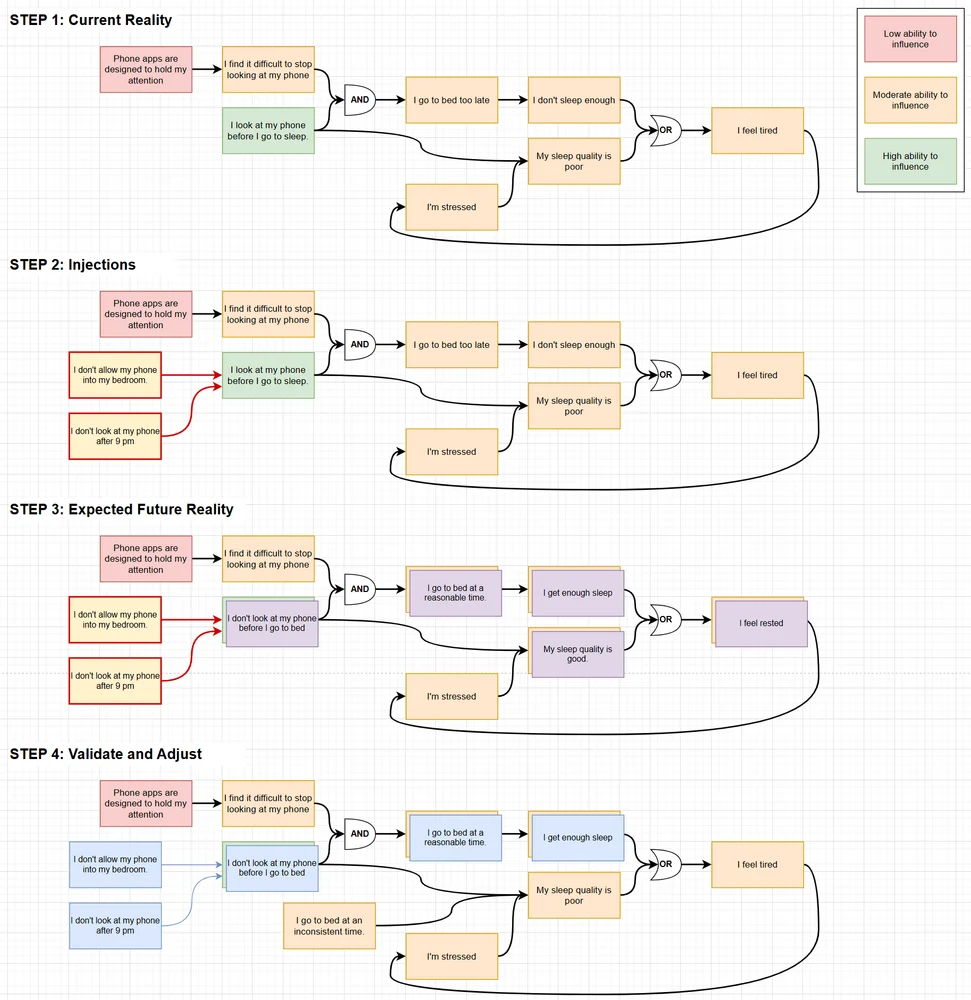
The diagram attached to this blog depicts this method using a relatable, non-work problem (feeling tired), which I'll refer back to as we walk through the four-week sprint.
Week 1: Mapping the Current Reality
I start by speaking to the people who felt the need to hire me. They’ve identified that something is off, so they are the ones to point me in the right direction. My goal in this initial interview is to understand:
- The specific "symptom" being experienced.
- The impact on the business.
- How they believe it is being caused.
- What the desired "Future Reality" looks like.
In our example diagram, the problem is "I feel tired." Initial assumptions might be "I'm not getting enough sleep" or "I'm getting poor quality sleep."
From there, I broaden the search: I speak to stakeholders across the board—from leadership to the most junior team members. Perspectives from the "front lines" are often the most enlightening. Throughout this process, I categorize every element of the "Current Reality Tree" on two criteria:
- Desirability: Is this a positive, negative, or neutral factor? (Not every cause is a problem; some desirable things can lead to undesirable effects).
- Influence: Is this Highly, Moderately, or Minimally influenceable?
By the end of Week 1, I back-brief the stakeholders on the reality I’ve uncovered and how I intend to test it in Week 2.
Week 2: Discovery and "Injections"
Week 2 is about independent verification. I observe the work in progress to confirm the tree we built in Week 1 is accurate. I look for data to prove which postulated causes are actually the "root."
Once verified, we identify Injections. An "Injection" is a specific change we introduce to the current reality to force a shift toward the desired future. In the blog diagram, step 2 shows two injections which are potential changes I can do to prevent me from looking at my phone before I go to sleep, and the purple shapes in step 3 show how we expect these changes to lead to a different future reality.
We brainstorm every possible improvement and then categorize them numerically by Effort vs. Impact. By sorting these by their Value-to-Effort ratio, we identify the high-leverage moves: the changes that give us the biggest shift with the least amount of friction.
I present this prioritized list to leadership to get buy-in for Week 3. The rule: no injection selected for the initial pilot should take more than one week to implement – this is merely because I only have two weeks left in my initial engagement, and we need to implement and verify any changes I implement in that time.
Week 3: Initial Implementation
We start executing the chosen injections. This is where the human element is critical. I’ve found that "it’s better for the company" is a poor motivator for people if the change makes their own working life harder.
For a change to be sustainable, it must be designed to make the daily life of the person enacting it better. Often, this requires building a new tool or a "hacked but functional" system to simplify the new process. If it’s easier to do the "new way" than the "old way," the change will stick.
Week 4: Validation and Adjustments
In the final week, we compare the "Expected Future Reality" against the "New Current Reality." We work from the point of injection forward toward the original problem.
- Best Case: The predicted reality matches the new reality.
- Alternative: There’s a mismatch. This isn't a failure; it’s intelligence. It indicates our initial model was incomplete or inaccurate. The change we made has acted as a "probe," revealing the true hidden causes.
In the blog diagram, step 4 shows that although we made the changes regarding looking at my phone before bed and this did cause me to get enough sleep, it didn't seem to improve my sleep quality and was still feeling tired. We therefore presented another possible cause for my low sleep quality, being that I go to bed at an inconsistent time, and we would want to consider new injections to address this issue.
The Handover
At the conclusion of the four weeks, you are left with:
- A verified, high-precision map of your current and desired future state of operations.
- Functional changes already implemented that have had a real, verified impact.
- A clear, prioritized list of remaining improvements you can implement yourselves (or engage me to lead).
We trade the fog of "chaos" for a clear, engineered path to velocity.